
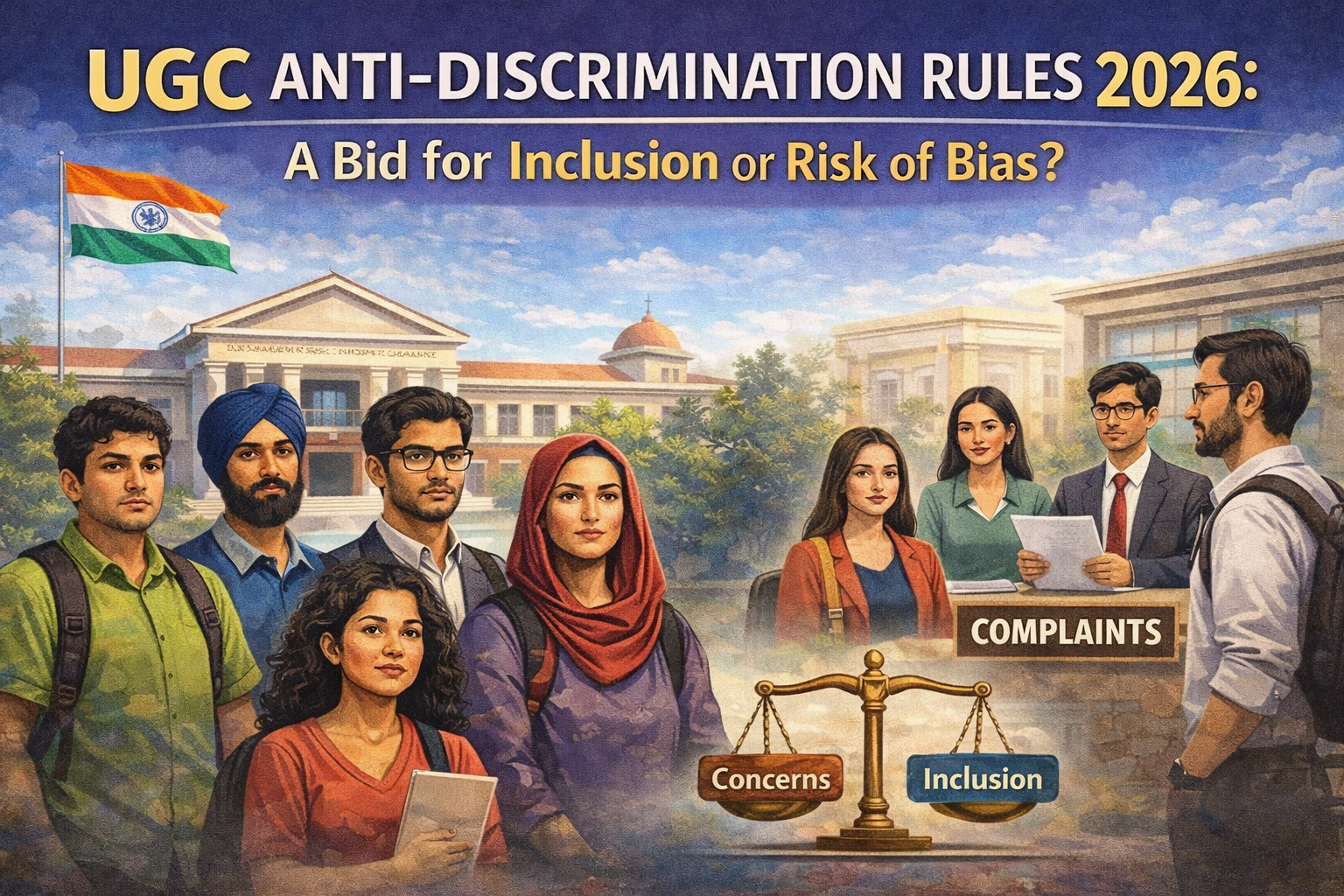
In 2026, the University Grants Commission (UGC) introduced new anti-discrimination rules aimed at making Indian higher education more inclusive and fair. These rules focus on protecting students from caste, gender, religion, disability, and economic-based discrimination.
While many have welcomed the move, others worry about possible misuse and administrative challenges. So, are these rules a step forward—or do they create new risks? Let’s understand.
What Are the UGC Anti-Discrimination Rules 2026?
The UGC Anti-Discrimination Rules 2026 are designed to:
- Prevent discrimination in colleges and universities
- Ensure equal treatment of all students
- Provide a formal grievance redressal system
- Promote diversity and inclusion on campuses
Every higher education institution must now form an Anti-Discrimination Cell (ADC) to handle complaints.
Key Features of the New Rules
1. Mandatory Anti-Discrimination Cell
Each university must set up an ADC with trained members to address student complaints confidentially.
2. Protection for Vulnerable Groups
Special attention is given to students from:
- SC/ST/OBC communities
- Minority groups
- Economically weaker sections
- Students with disabilities
- LGBTQ+ students
3. Time-Bound Complaint Resolution
Institutions must resolve complaints within a fixed time to avoid delays.
4. Awareness Programs
Colleges are required to conduct workshops and campaigns on equality and respect.
Why Were These Rules Introduced?
Several cases of student harassment, social exclusion, and mental health crises highlighted the need for stronger protection systems.
The UGC aims to:
- Reduce dropouts
- Improve mental well-being
- Create safe learning environments
- Promote social harmony
Benefits: A Step Toward Inclusion
Safer Campuses
Students feel more confident reporting unfair treatment.
Equal Opportunities
No student should be denied resources due to background.
Better Academic Environment
Respect and diversity improve learning outcomes.
Stronger Institutional Accountability
Universities are answerable for negligence.
Concerns: Risk of Bias and Misuse
False Complaints
Some fear that the system may be misused for personal conflicts.
Administrative Burden
Small colleges may struggle to manage new compliance rules.
Subjective Judgments
Discrimination cases are sometimes hard to prove.
Possible Over-Regulation
Too many rules can slow down decision-making.
Balancing Inclusion and Fairness
To make these rules effective, institutions should:
- Ensure transparent investigations
- Train committee members properly
- Protect both complainants and accused
- Use digital complaint systems
- Encourage mediation when possible
What This Means for Students and Parents
For students, these rules offer legal backing and emotional security.
For parents, they ensure safer academic spaces for their children.
However, awareness is key. Students must understand both their rights and responsibilities.
Expert Opinions and Public Reactions
Education experts largely support the move but recommend:
- Regular audits
- Independent oversight
- Data-driven evaluations
- Student participation in policymaking
Public opinion remains divided but hopeful.
Conclusion
The UGC Anti-Discrimination Rules 2026 mark an important milestone in Indian education. They aim to build inclusive campuses where talent matters more than background.
While challenges exist, with proper implementation, these rules can transform higher education positively.
Inclusion should never mean unfairness—and fairness should never ignore inclusion.
FAQs
Q1. Are these rules mandatory?
Yes, all UGC-recognized institutions must follow them.
Q2. Can students file complaints online?
Most institutions are encouraged to offer digital portals.
Q3. Is anonymity allowed?
Some universities allow confidential reporting.
Q4. What happens if rules are violated?
UGC may take disciplinary action against institutions.